
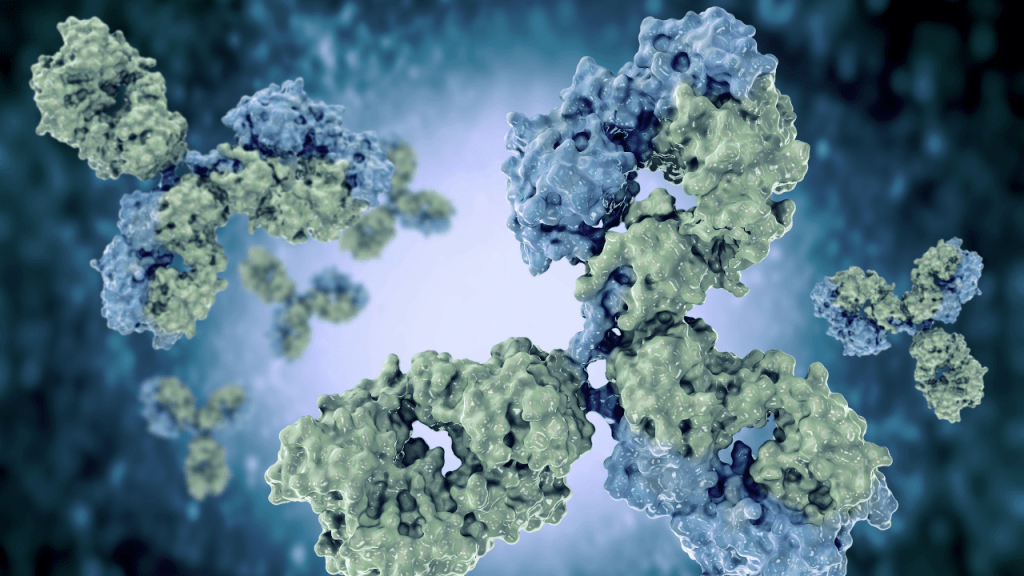
RFAntibody creates epitope-specific antibody binders with atomic-level agreement
Designing antibodies that bind a specific epitope normally requires immunization or screening millions of variants. Traditional workflows take months and often miss therapeutically relevant binding sites. A new study shows that it is now possible to generate antibody candidates entirely on a computer, then confirm their structures experimentally, including at atomic resolution.
Background
Current antibody discovery methods rely on animal immunization, patient-derived antibodies, or large-scale random library screening followed by epitope mapping. These approaches are slow, resource-intensive, and may fail to identify binders to difficult or highly specific epitopes. Antibody discovery is further complicated by the need to shape complementary-determining region (CDR) loops that make precise “fingertip” interactions with a target.
Computational approaches have helped optimize existing antibodies, but no method had previously been able to design epitope-specific antibodies from scratch. Earlier work demonstrated that RFdiffusion could generate single-domain VHH binders; the present study extends these capabilities to full antibody variable regions.
The new approach
The authors fine-tuned RFdiffusion so that it can generate antibody variable domains that place new CDR loops around a defined epitope while keeping the framework fixed. The network receives a target structure, user-specified “hotspot” epitope residues, and a template of the antibody framework. RFdiffusion generates backbone structures, ProteinMPNN designs CDR sequences, and a fine-tuned RoseTTAFold2 model predicts structural self-consistency.
Yeast display or E. coli expression enables screening, while OrthoRep provides affinity maturation when needed. The targets tested in this study span bacterial toxins, viral proteins, and a cancer-associated peptide–MHC complex.
Key results
VHH binders across multiple targets
Across multiple targets, the redesigned RFdiffusion pipeline produced VHHs and scFvs that bound their intended epitopes with experimentally measurable affinities. For VHHs, the authors identified binders to influenza H1 haemagglutinin, RSV sites I and III, SARS-CoV-2 RBD, C. difficile TcdB, and IL-7Rα. The strongest affinities ranged from tens of nanomolar (influenza H1) to low micromolar (SARS-CoV-2). Epitope specificity was confirmed through competition assays, and one TcdB-binding VHH neutralized toxin activity in cells.
Structural validation of VHHs
High-resolution structural analysis established how closely the designs matched reality. A cryo-EM structure of a designed influenza VHH resolved to 3.0 Å and aligned with the computational model at 1.45 Å RMSD for the backbone and 0.8 Å for the CDR3 loop. Designed TcdB VHHs also bound in the intended orientation, both before and after affinity maturation.
scFv binders from combinatorial pairing
The authors extended the approach to full scFvs by combining heavy and light chains from structurally similar models. Several scFvs bound the TcdB Frizzled epitope with affinities down to 72 nM, and full-length IgG1 versions retained similar affinities. Cryo-EM structures of two scFvs confirmed accurate docking and near-atomic agreement across all six CDRs.
Binders to a peptide–MHC target
Finally, the pipeline generated scFvs that recognized the PHOX2B–HLA-C*07:02 peptide–MHC complex with moderate affinity and high peptide specificity, expanding the demonstration to a clinically relevant pMHC target.
Broader significance
The paper explicitly notes that the key advance is accurate targeting of specific epitopes, enabling antibody designs that avoid competing with endogenous molecules or target conserved viral epitopes. The authors also report that the RFantibody software used in this study is openly available on GitHub. They note that improved versions of the method could accelerate antibody discovery and broaden the range of biomolecular targets accessible to rational design.