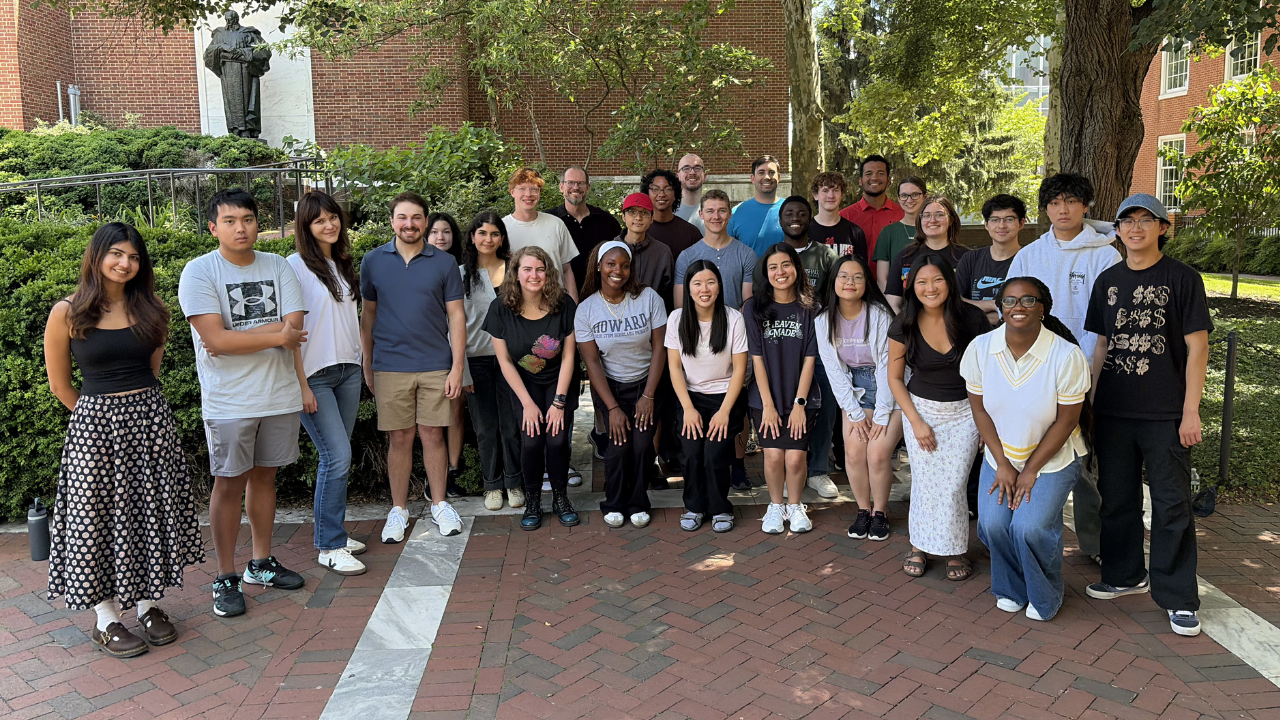
Rosetta Commons Research Experience for Undergraduates (REU) Program
AI for Biomolecular Structure Prediction and Design
- Program Dates: June 8, 2027 - August 13, 2027
- The program starts with one week of Rosetta Code School (June 8 through June 12), where you will learn the inner details of the PyRosetta and AI-based code and the community coding environment, so you are fully prepared for the summer!
- Eight weeks of hands-on research in a molecular modeling and design laboratory, developing new algorithms and discovering new science.
- The summer will finish with a trip to Summer RosettaCon conference at the University of Washington in Seattle, where you will present your research in a poster and connect with Rosetta developers from around the world. The conference will be held from August 9 through August 13.
- This program is supported by NSF (award 2548392) . Interns will receive housing, paid travel expenses, a sustenance allowance, and a $7,000 stipend.
"My summer research experience was incredible. I had the chance to travel the country and meet a variety of impressive researchers and develop strong relationships with the members of my REU cohort. It was empowering working on a project to solve a prevalent real-world problem, and have my solutions wet-lab tested. It truly felt like I was a researcher instead of a student acting as one."
"I had a fantastic experience this summer! I had high expectations when I accepted the Rosetta Commons REU offer, and the summer more than delivered!"
"Overall, this was a great introduction to research for me. I was doing wet lab work, and I felt I gained a lot of knowledge about different experiments as well as how the problem solving process works specifically in a wet lab setting."
"Working on an environmental issue was really interesting because when you first hear protein design you assume that it is related to health topics. It was cool to see another one of limitless applications that this type of research has."
"I found the research experience quite intimidating at first, since I didn't have much previous research experience and would have to learn a bunch of new technologies to succeed. Toward the end of the summer, I found the research to feel more like a routine than something to worry about, as I was able to more regularly figure out what I should do next on my own."
“Everyone in my lab was very nice. They gave great advice on grad school, shaping a new perspective for me. I gained a new, broader view on what kind of research is even possible and the approaches people take to achieve their goals.”
"Throughout the summer, my peers became an important resource and support network for my growth as a scientist and person. I had a wonderful experience learning about what it was like to live in both a new research environment and a new country. After my research experience, I am considering applying to research programs abroad."
"I valued the opportunity to learn about my labmates' research and to hear about their individual paths through graduate school, which gave me a clearer sense of what a career in this field could look like."
Available Projects and Locations

"Design of Games for Citizen Science Biochemistry"
Designing games for citizen science presents many challenges, as the games need to be both engaging and address a real-world problem. We are exploring methods to support the design of such games, including performing studies to understand rewards and developing techniques for generating puzzles.