

REU Trainees’ Research Projects Highlight Exciting First Steps in Biomolecular Research
REU trainee Tony Peonio presenting his lightning talk at Summer RosettaCon 2026.
This is part three of a three part series about the Rosetta Commons REU experience.
How do you remove sargassum blooms impacting coastal marine ecosystems? Can we design an enzyme that breaks down fluorochemicals? How can we reduce chronic pain and inflammation in humans? And how do we develop effective treatments against antibiotic-resistant bacteria?
These are big, complex, real-world challenges, and trainees in the Rosetta Commons Research Experience for Undergraduates (REU) program took them on in their summer research projects.
For over a decade, the REU program has gone beyond simply teaching the next generation of scientists how to conduct research. By matching trainees to projects with real-world impact, the program addresses some of the most prominent questions in biomolecular modeling and design. At the same time, these projects allow principal investigators (PIs) to explore new topics and methods on a smaller scale before expanding them further in their labs.
Hands-On and Computational Explorations
“Overall, this was a great introduction to research for me,” said trainee Allie Gibson, whose research focused on testing an experimental design to investigate antibody binding patterns using known public viral epitopes. “I felt I gained a lot of knowledge about different experiments as well as how the problem solving process works specifically in a wet lab setting.”
While some trainees gained wet lab experience, many others spent the summer exploring computational modeling and design, creating blueprints that will undergo wet lab testing as a follow-up to their work.
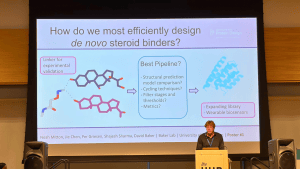
REU trainee Noah Mitton presenting his lightning talk at Summer RosettaCon 2026.
Trainee Noah Mitton worked on a group project to optimize pipelines for designing de novo proteins that bind small molecules, targeting cortisol, progesterone, and melatonin. “After several optimization steps and exploring with different methods, I was able to find statistically significant results between structural prediction models,” he said.
Trainee Martina Madrzak worked on designing a universal protein binder for the H3 strain of influenza using a full computational machine learning pipeline. Her work incorporated tools such as RFdiffusion, ProteinMPNN, AlphaFold2, and Rosetta Relax to design, predict, and refine candidate binding proteins. “I found learning about RFdiffusion’s model architecture and diffusion process very interesting: how it starts from random noise and iteratively denoises it into a protein backbone structure, which can then be refined with sequence design too,” she said.

REU trainee Martina Madrzak presenting his lightning talk at Summer RosettaCon 2026.
Similarly, trainee James Zhu focused on designing proteins that target Rgg3, a transcriptional regulator involved in quorum sensing in Streptococcus bacteria. Using BindCraft, a deep-learning-based protein design pipeline, James generated hundreds of candidate protein binders. “Based on these computational analyses, we prioritized six promising designs for experimental testing,” he said. “By interfering with Rgg3 signaling, a designed binder could potentially disrupt bacterial communication without directly inhibiting bacterial growth, providing an alternative direction for developing anti-virulence therapeutics.”
Tackling Global Challenges
Other trainees applied carbohydrate-binding modules and enzyme design to tackle pressing environmental issues. Francisco Jimenez focused on marine ecosystems: “My work focused on creating a protein that can bind to the polysaccharide (alginate) that is especially prevalent in sargassum to break it down more effectively so that it can potentially be used for biofuels,” he said.
Olivia Kong also targeted large-scale environmental solutions through enzyme engineering. “My goal for the summer was to design an enzyme that degrades fluorochemicals, and after a long search I found the fluoroacetate dehalogenase (FAcD) enzyme which after some tweaking looked promising based on our computational designs, so I am excited to see how our designs turn out in the wet lab,” she said.
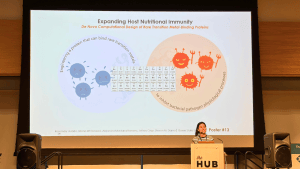
REU trainee Rosemary Jurado presenting his lightning talk at Summer RosettaCon 2026.
The drive toward real-world impact also resonated with trainee Rosemary Jurado. Her research focused on engineering S100 family proteins to bind transition metals such as vanadium and zinc—work motivated by nutritional immunity, the body’s process of withholding essential metals from invading bacteria to fight antibiotic-resistant infections.
“Through this process I identified and fixed multiple underlying bugs in the pipeline’s code, validated my designs through structural alignment and independent computational checks, and produced a confirmed zinc-coordination site design on S100A1, an experience that sharpened my skills in rigorous troubleshooting, adapting to unexpected results, and connecting molecular design work to its broader real-world motivation,” she said.
Looking Ahead
With the summer program wrapping up, several trainees plan to continue their work after becoming deeply invested in their projects.
“I will be staying as a volunteer researcher with the lab, continuing to work virtually to try to solve the problem of chronic inflammation,” said trainee Tony Peonio.

REU trainee Kelvin Lartey presenting his poster at Summer RosettaCon 2026.
Trainee Kelvin Lartey is also exploring ways to keep working on his project, which focuses on phylogenetic tree frameworks used to reconstruct extinct protein sequences. “When it comes to the project, I really loved it,” he said.
Click to view the full list of summer research projects and their poster abstracts for Summer RosettaCon 2026.
To read more about their first week in the REU program, check out part one of the Rosetta Commons REU experience series. To read more about their summer and conference experiences, check out part two of the Rosetta Commons REU experience series.