
Coding, Collaboration, and Camaraderie: REU Trainees’ Introductory Bootcamp 2026
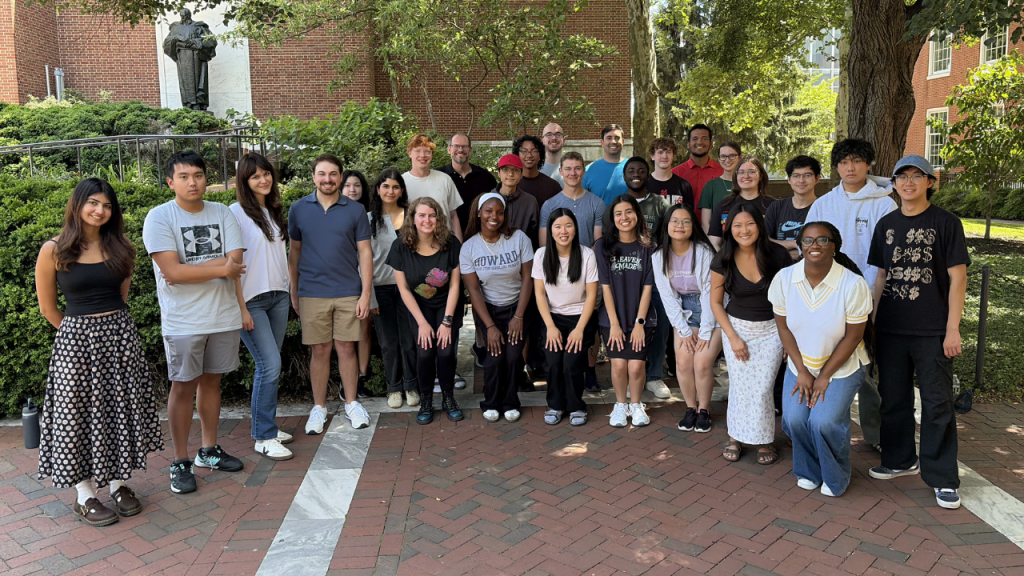
Featured image is of Code School 2026 attendees, including REU trainees, instructors Nate Felbinger and Miranda Simpson, teacher assistants Briana Whitehead, Vani Lorish, and Zhazira Iskakova, and PI Jeffrey Gray.
This is part one of a three part series about the Rosetta Commons REU experience.
For over a decade, on the first week of June, a new cohort of National Science Foundation and Rosetta Commons funded undergraduate trainees attend a week-long Code School, also known as REU Bootcamp. The Rosetta Commons Research Experience for Undergraduates (REU) program places top-performing undergraduate students in labs across the U.S. and Europe for an eight-week, hands-on research project in biomolecular modeling and design.
This year, trainees completed Code School at Johns Hopkins University where they participated in lectures and labs to learn the basics they need to be successful in their research projects. This year, 23 trainees arrived with strong foundations in biology, chemistry, engineering, or computer science and learned about computational foundations, hands-on tool fluency, and conceptual frameworks needed for their research projects. Structured around modern protein design pipelines, the program introduced physics-based methods with Rosetta tools and machine learning tools used for structure prediction, backbone generation, and sequence design.
For the first time this year, trainees also worked in groups on a design project. The goal was to take everything they learned and create a de novo binder against an important target, for example to treat a disease. They self-selected their team based on the friendships they had made throughout the week. “The project was a success, and I think they learned a lot,” said Miranda Simpson, the co-instructor.

REU trainees Marwa Naji, Steven Engelbretson, and Martina Madrzak (left to right) work on their binder design project alongside instructor Miranda Simpson and teacher assistant Zhazira Iskakova.
The binders they designed were in silico candidates and in a real project the next steps would be to synthesize and test their design in a wet lab, a process some trainees might do as part of their research project at their host labs. However, despite their best efforts, some of the binders they dedicated so much time to producing were not viable, because they were trying for a more complicated design. But, despite some disappointing results, the enthusiasm and effort of the trainees did not falter, and they all presented an impressive analysis. “We are fortunate to get to help such a capable group of young researchers grow,” said Nate Felbinger, the instructor.
The trainees had long days from 9 a.m. to 9 p.m. packed with lectures, hands-on activities, and teamwork, but that didn’t stop them from having at least a little fun as they made new friends. One night, the group went to the local Baltimore ice cream spot, The Charmery, and shared stories of downtime activities they were able to squeeze in, including visiting the National Aquarium and local art museums. These experiences only enhanced their friendships as they began their research journeys.
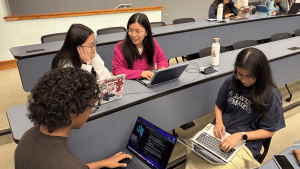
REU trainees Iris Zheng, Olivia Kong, Rosemary Jurado, and Daniel Martinez (clockwise from upper left) work on their binder design project.
“There is so much positive energy to learn powerful tools for biomolecular design and to apply them for diverse good purposes,” said Jeff Gray, the program’s PI. And that excitement was evident when each trainee was asked what they looked forward to the most. All of them couldn’t wait to get to their host labs, apply what they learned from Code School, and dive into solving real-world challenges, including those around curing diseases, drug discovery, personalized medicine, and plastic pollution.
“I know that chemistry is the closest thing we have to magic, so being able to learn how to design enzymes that do certain functions such as catalyze reactions, can be very useful to apply to all sorts of environments and applications,” said Olivia Kong, one of the trainees. Meanwhile, trainee Peter Le shared, “I’m most excited about developing a protein-base nanobot that can eventually be used for drug delivery.”
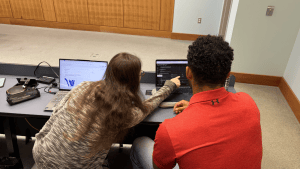
REU trainees Hannah Lott and Colter Bufford work on their binder design project.
Not only are they eager to learn and apply that knowledge, but they want their impacts to benefit society.
“There are multiple ways to help patients that aren’t bedside,” said trainee Rosemary Jurado. “Discovering how different proteins work can impact patient health, so you no longer have to be only a doctor or a nurse to help people,” she added.
Trainee Iris Zheng is also looking for new ways to help people, especially in underserved communities, through developments in personalized medicine. “I think the field of biology will move towards using deep learning to construct biological models, and that’s one of the big breakthroughs we can make to create personalized medicine,” she shared.
Not all impacts will be in the health sector, though, as several of these trainees also want to make a difference in computational methods. Trainee Tony Peonio stated, “Biomolecular engineering feels like one of the strongest fields where computation is still a limitation, and I want to be one of the people who help to bring it into the quantum realm.”
With motivated, passionate trainees like these, the REU Bootcamp was only the start of their scientific journeys. The future is theirs for the making.
The 2026 Rosetta Commons REU Trainees were hosted at:
- Colter Bufford, Southern Nazarene University
- Steven Engelbretson, University of Texas Austin
- Allie Gibson, Georgetown University
- Lia Headley, Howard University
- Kegan Hitt, Worcester Polytechnic Institute
- Francisco Jimenez, Queens College, City University of New York
- Rosemary Jurado, Bowie State University
- Olivia Kong, University of California, Berkeley
- Shuaicheng Lai, Johns Hopkins University
- Kelvin Lartey, Franklin and Marshall College
- Peter Le, University of California, Irvine
- Celeste Litchfield, Brigham Young University
- Hannah Lott, University of Tulsa
- Andy Luu, Swarthmore College
- Martina Madrzak, Florida State University
- Daniel Martinez, University of Maryland, Baltimore County
- Noah Mitton, Whitworth University
- Marwa Naji, Johns Hopkins University
- Tony Peonio, Colorado School of Mines
- Alan Talavera, Saddleback College
- Sina Yarmohammadi, Stanford University
- Iris Zheng, Johns Hopkins University
- James Zhu, Pomona College
The trainees shared the results from their summer research projects at Summer RosettaCon 2026 in Seattle with lightning talks followed by poster presentations. To read more about their summer and conference experiences, check out part two of the Rosetta Commons REU experience series. To explore the science they accomplished, check out part three of the series.