
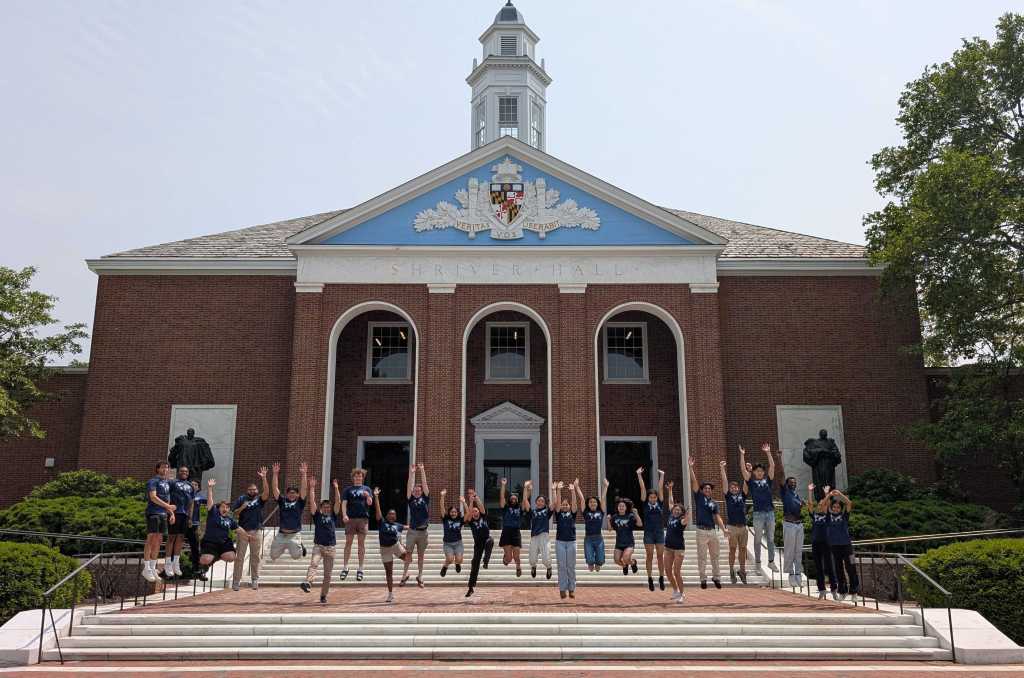
Introducing Rosetta Commons Research Experience for Undergraduates (REU) cohort 2025
We’re pleased to introduce the 2025 Rosetta Commons Research Experience for Undergraduates (REU) cohort.
Interns in this REU program, which is hosted across multiple locations, engage in research using the Rosetta Commons software. This software library provides tools for computational modeling and analysis of protein structures. It has supported major scientific progress in computational biology, including de novo protein design, enzyme engineering, ligand docking, and predicting structures for biological macromolecules and their complexes.
This year, we received 613 applications from students across the country—a reflection of the growing interest in biomolecular modeling and computational biology. Following a highly competitive selection process, 23 students have been accepted into the program.
Read a short introduction from 15 of these students, including their backgrounds and goals for the summer.

Richard Zhu: Hi! My name is Richard Zhu, and I am a junior at Harvard University, where I am pursuing an A.B. in Statistics, S.M. in Computer Science, and minor in Chemistry. I am interested in agentic AI, geometric machine learning, and the applications of such models to challenges in structural biology, drug development, and other fields of biomedicine. I am currently an undergraduate researcher in Professor Marinka Zitnik’s lab at Harvard Medical School, where I am working on the team to develop TxAgent, an AI agent built for multi-step, knowledge-grounded therapeutic reasoning using a massive toolbox. This summer, I will be working in Professor Jeffrey Gray’s lab on deep learning methods for modeling protein interactions, and I am very excited to learn as much as I can about deep learning for structural biology, get to know my fellow interns in the REU, and be a part of the Rosetta community!
Alina Yildirim: Hi! I’m Alina, a Computer Science student at Smith College with a strong interest in bioinformatics. My current research involves using natural language processing to compare human and mouse disease models. Outside of academics, I practice MMA, play chess, knit, and enjoy learning new languages. Through the REU program and my lab work at Merck, I’m excited to deepen my experience in computational biology and chemistry as I prepare for graduate school.
James Hillers: This summer I’m looking forward to getting to apply deep learning protein design methods to aid in the design of small proteins and antibodies. I hope this experience will be transformative in learning more about the positive impact this research can have and the research I want to pursue post-undergrad.
Isabella King: Hello! I am Isabella King, a sophomore Computer Science Major and Statistics Minor at San Diego State University. I am interested in health and bioinformatics research. I aspire to make an impact with my research and help improve the world. Additionally, I am excited to make new friends and connections with all the amazing people at this REU. I am thrilled to be part of the Rosetta Commons REU this summer.

Luis A. Landrau-Correa: My research interests lie at the intersection of biophysics, particularly protein structure and folding, cell membrane dynamics, and cell signalling. I believe that the future of scientific innovation is intertwined with computational approaches. Being part of the Rosetta Commons REU program will steer me in the right direction to achieve my professional goal of pursuing a PhD in Biophysics. Through this program, I aim to boost my knowledge of protein design and enhance my skills in conducting in silico studies, such as simulations and computational modelling, and all while enjoying the process. I am thrilled to continue my learning journey in the Glasgow Lab at Columbia University, where I will be exposed to exciting research!
Mimosa Van: I am interested in metabolism research and understanding how cellular processes and pathways perform, achieving living systems and organisms. Furthermore, I am interested in harnessing biological pathway knowledge to synthesize biotechnology applications in medicine and agriculture. In the Rosetta Commons REU, I hope to achieve a greater understanding in using AI and proteins, using my biochemistry knowledge, and a greater appreciation in the intersection of biology and technology.
Andrew Fadgen: Though my current research focuses on molecular dynamics simulations of multi-phase systems, my curiosity spans across nearly all areas of chemistry. I’m especially captivated by thermodynamics and kinetics, particularly in unconventional contexts—such as at interfaces, within nanomaterials, or in complex polymer systems. I’m excited to dive into the world of computational protein design with Rosetta Commons and explore how we can engineer biomolecules to perform functions that are challenging or even impossible with traditional small-molecule chemistry. When I am not in the lab or class, I enjoy my time by making art, listening to music, spending quality time with friends, or cooking/baking!
Meghana Indukuri: Hello! My name is Meghana, and I am an undergraduate student studying Software Engineering at San Jose State University. My current research interest mainly lies in deep learning applications for biological domains. Specifically, I have been conducting research on machine learning for 3D genomic data, which has allowed me to explore a small subsection of computational biology. I am excited to explore this domain further through the Rosetta Commons REU! At the University of Washington’s Baker Lab, I hope to research deep learning for protein design, gaining more knowledge in this extensive field. I would love to grow my skills in interdisciplinary research and build new connections in the research community.

Nonso Duaka: I have been involved in molecular toxicology research, studying small molecules like environmental toxins and their effects on cells. My work has also explored the inflammatory microenvironment of cancer cells and how molecular interactions influence disease progression. More recently, I have developed a strong interest in using computational methods to analyze these small molecules, leveraging cheminformatics, molecular modeling, and protein design to uncover insights that can contribute to drug discovery. In my free time, I enjoy singing, practicing my guitar, or reading a Novel.
Syed Moiz: My time is spent exploring the intricacies of the ever expanding digital plane, and if I’m not at my desk coding, you’ll catch me outside playing basketball, snowboarding, and reading about fashion. Aligning perfectly with my interests The Rosetta Intern REU program intersects technology with innovation and human connection. I look forward to pushing the boundaries of my skills, learning from top researchers, and developing solutions that speak to both technical excellence and everyday life
Linxi Cai: Hi everyone! My name is Linxi Cai, and I am a Biophysics major at Amherst College (Class of 2027). I am thrilled to be joining David Baker’s lab this summer as part of the Rosetta REU program. My research interests lie at the intersection of molecular dynamics in biological systems, computational modeling, and engineering. Through this program, I hope to deepen my understanding of protein design and learn how use computational tools for innovations in biomolecular engineering!
Karen Garcia: Through the Rosetta Commons REU Program, I’m excited to join the Drew Lab and apply computational approaches—from protein modeling and machine learning to structure prediction—toward therapeutic development. At the Rosetta Code School, I look forward to expanding my computational biology skills alongside a talented cohort while bridging the gap between wet lab research and computational drug discovery as a Biomedical Engineering major and Computer Science minor. I’m particularly excited to master Rosetta’s tools for protein design, ligand docking, and macromolecular modeling through this program. This experience will be transformative as I work to develop innovative therapies, and I can’t wait to engage with the Rosetta community at RosettaCon! Between research sessions, I also can’t wait to explore Chicago’s vibrant scientific community and cultural scene!

Kiyan Abel: My interests lie at the intersection of machine learning, immunology, and pathology, with a growing focus on protein engineering. I’m especially excited by how computational tools can help us better understand immune responses and design proteins with therapeutic potential. The Rosetta Commons REU program offers an incredible opportunity to bridge my dry lab experience with my wet lab work in directed evolution to enhance protein function. By gaining a deeper understanding of protein structure and modeling, I hope to strengthen the foundations for my current research and contribute to projects with real-world biomedical impact.
Kamille Watkins: Hello! My name is Kamille Watkins, and I am a sophomore Health Science major and Computer Science minor on the pre-MD/PhD track from Prince George’s County, Maryland. I am thrilled to be a part of the Rosetta Commons REU program, where I hope to gain first hand experience at the intersection of computational science and biomedical research. With a strong interest in protein modeling and structural biology, I’m excited to apply the Rosetta software to real world challenges and expand my skills in data driven research. Through this experience, I aim to contribute meaningfully to my research team, build connections with mentors and peers, and further prepare for a career as a physician-scientist committed to advancing medical innovation and health equity.
Yaejie (Gia) Kwon: I am currently a sophomore at Swarthmore College, majoring in Computer Science and Statistics. This summer, I’m thrilled to join the Rosetta Commons REU program at the Cooper Lab at Northeastern University, where I’ll contribute to enhancing Foldit, an interactive protein folding game. As someone new to biochemistry, I’m especially excited to explore how computational approaches can deepen our understanding of biological processes. Through this experience, I hope to gain hands-on research skills and connect with a supportive community of researchers.