
Advancing Protein Design in Latin America: October 2026 Workshop & Symposium Recap
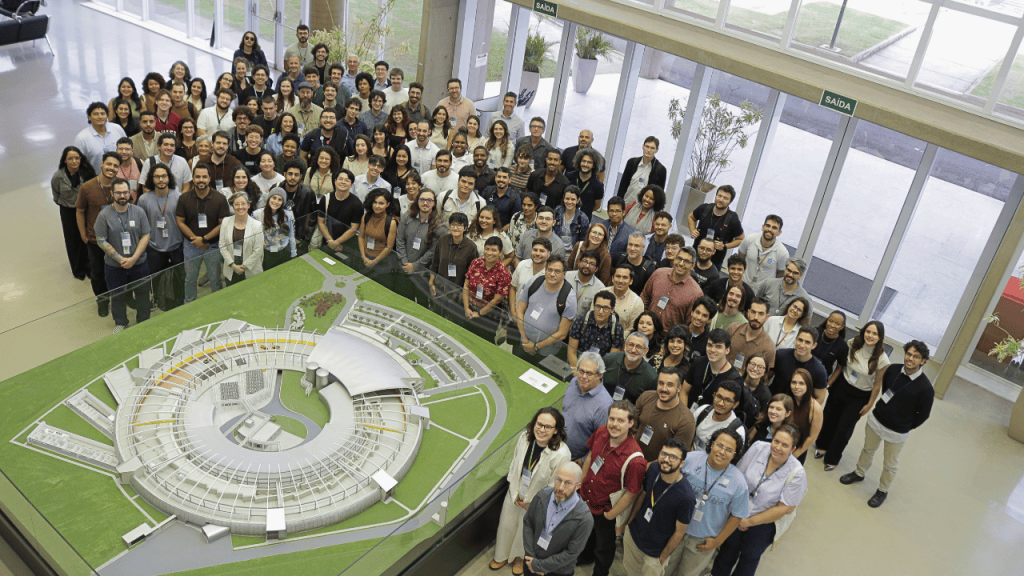
Featured image is a group photo of attendees during a tour of the Brazilian Center for Research in Energy and Materials (CNPEM). Credit: Helder Ribeiro
With around 150 participants from 9 countries and every region of Brazil, 14 scientific talks, 70 posters, and a two-day hands-on workshop, the Workshop AI for Protein Design and 2nd Symposium on Protein Design and Engineering (RosettaCon Brazil) brought together a vibrant international community in Campinas, Brazil. Hosted at the Brazilian Center for Research in Energy and Materials (CNPEM) from October 5-8, 2026, with support from Rosetta Commons, the event showcased the rapid growth of computational and experimental protein engineering across Latin America.

Ingemar Andre teaching workshop participants about PyRosetta. Credit: Helder Ribeiro
Bridging Fundamentals and AI in the Hands-On Workshop
The event kicked off with a dynamic two-day hands-on workshop that welcomed around 30 participants from 6 countries and all regions of Brazil. Designed to bridge foundational concepts with cutting-edge artificial intelligence, the training covered:
- Fundamentals of Protein Structure and Design: Led by RosettaCommons members Ingemar André (Lund University) and Sinisa Bjelic (Linnaeus University).
- AI-Based Protein Design: Led by Pablo Arantes (industry), focusing on modern machine learning applications in the field.
Although participants arrived with varying levels of prior experience in protein modeling and design, the sessions were marked by lively Q&A, active peer-to-peer troubleshooting, and enthusiastic discussions throughout the exercises.

Attendees socializing during a break at the Symposium. Credit: Helder Ribeiro
Exploring Real-World Applications at the Symposium
Over the following two days, the symposium featured a packed schedule of talks exploring protein design from diverse perspectives—spanning experimental and computational workflows, as well as physics-based and AI-driven methodologies. Speakers highlighted concrete, real-world applications ranging from novel biosensors and enzymes to therapeutic agents, illustrating the broad impact of modern protein engineering.
Between sessions, shared breaks and social gatherings gave attendees space to exchange experiences, discuss ongoing projects, and spark new collaborations. The poster session served as a central highlight of the symposium, offering students and early-career researchers a relaxed, friendly environment to present their work and connect directly with senior scientists and invited speakers.
Attendees discuss science during the poster session at the Symposium Credit: Helder Ribeiro
Inside Sirius and Brazilian Biosciences
Rather than taking place in a traditional tourist venue, the meeting offered attendees a unique scientific excursion right on campus. Guided tours introduced participants to Sirius, Brazil’s fourth-generation synchrotron light source, as well as the Brazilian Biosciences National Laboratory (LNBio). Visitors learned how protein structures are experimentally determined and characterized at beamlines named after elements of Brazilian biodiversity—including Manacá (X-ray crystallography) and Sapucaia (SAXS).
Attendees during a tour of the Brazilian Center for Research in Energy and Materials (CNPEM). Credit: Helder Ribeiro
Looking Ahead for Protein Design in Latin America
By combining practical Rosetta training with high-level scientific exchange, the 2026 workshop and symposium helped expand access to recent advances in protein design across Brazil and Latin America.
“We plan to continue organizing this workshop and symposium regularly in Brazil, especially in coordination with upcoming AI4PD events in Chile, led by Cesar Ramirez-Sarmiento and other Rosetta Commons members, helping to expand the Rosetta community across the region and strengthen the protein design community in Latin America,” said Helder Ribeiro, one of the event organizers.
Thank you to our speakers, instructors, sponsors, and the team at CNPEM for making this event possible.