
Tool Updates
New OpenBind-0 model and dataset benchmark co-folding tools in drug discovery
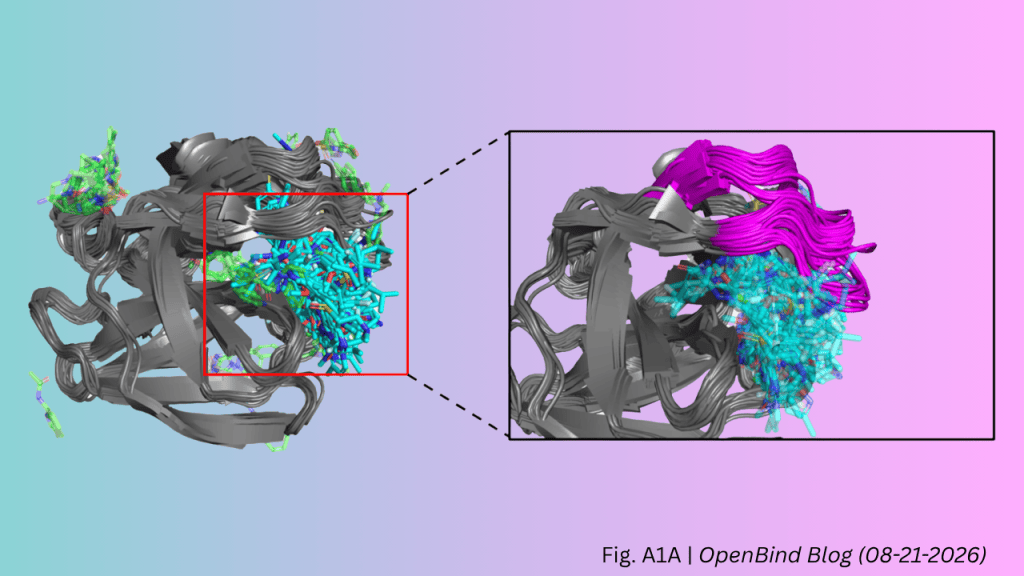
Key Takeaways OpenBind-0 (OB0) is a fully open-source co-folding model built on OpenFold3, trained on Protein Data Bank (PDB) data, and optimized for predicting protein–small-molecule complexes. Alongside the model, a discovery-relevant benchmark dataset of 717 new ligand-bound structures capturing fragment-to-hit progression across FatA and RdRp targets was released. Evaluation across targets shows wide performance variability,…
Read MoreSpeed Up PyRosetta Development with Autocompletion and Type Checking
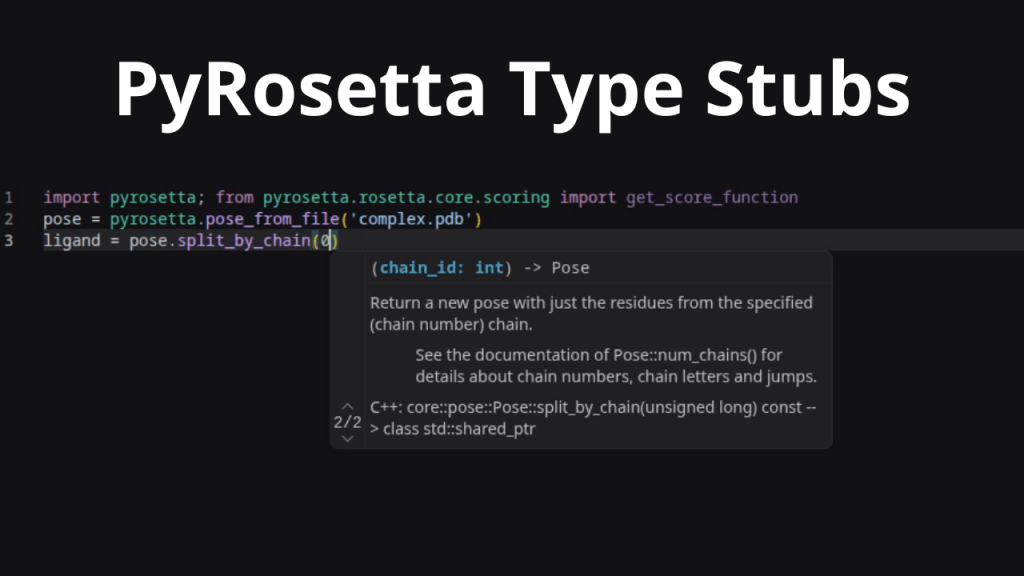
By Harrison Truscott PyRosetta, the Python interface to the Rosetta binary, now comes packaged with type stub files (.pyi). These files describe the module’s classes, methods, and variables, as well as function signatures, types of function parameters and return values, and descriptive docstrings. Type stub files can be used by the Integrated Development Environment (IDE)…
Read MoreRosetta Commons Run (rc-run) Now Available

We are pleased to announce a new Rosetta Commons workflow optimization tool: rc-run. rc-run (invoked as rc) is a command-line utility tool for running containerized and native biomolecular software. It simplifies common tasks, such as mounting local directories, building HPC containers, running containerized applications, and logging executed commands, to make complex workflows easier to reliably…
Read MoreQuarterly PyRosetta builds now available
We are happy to announce the availability of quarterly PyRosetta builds. These builds provide persistent wheel packages that are retained long-term (potentially indefinitely), making it straightforward to create reproducible PyRosetta environments across all supported build flavors and Python versions. This is now the recommended installation path for users who need stability and reproducibility. Below…
Read MoreRFdiffusion3 is Now Available in foundry

The RFdiffusion3 (RFD3) training and inference code is now available through foundry. This third-generation model builds on RFdiffusion1 and RFdiffusion2, expanding the scope of what diffusion models can design. RFD3: Performs atom-level diffusion across both backbone and side-chain atoms Has a new denoising procedure that incorporates a forward step without conditioning information Restores symmetry design…
Read MoreRosetta + Cursor: Simplifying Protein Design with AI Assistance

The Rosetta MCP Server project, created by Ariel J. Ben-Sasson, is a powerful tool that will make it easier to use Rosetta, RosettaScripts, and PyRosetta in your protein design projects. It allows tools like Cursor – an AI-powered coding assistant that integrates with common code editors – to directly interact with the Rosetta/PyRosetta software to…
Read MoreRosetta 3.15 Release Highlights
The newest version of Rosetta is now available for download: Download Rosetta 3.15. In addition to general improvements, Rosetta 3.15 introduces several new protocols focused on modeling and designing small-molecule ligands and noncanonical amino acids. These include: Beyond protocols, Rosetta 3.15 adds new movers, filters, and chemistries to expand options for drug design, ligand docking,…
Read MoreAtomWorks & RosettaFold3 (in Foundry) now open-source on GitHub
We’re excited to share that two major repositories are live on the RosettaCommons GitHub: AtomWorks and Foundry. AtomWorks is a broadly applicable data framework for manipulating structural data and developing biomolecular foundation models across a wide range of biological tasks. AtomWorks has already been used to train structure prediction, generative protein design, and fixed-backbone sequence…
Read MoreRFdiffusion2 is Now Available On GitHub
The long awaited inference code for RFdiffusion2 is now public! Developed by the Baker Lab, RFDiffusion2 builds on the capabilities of RFdiffusion AA to model more complex enzyme structures than was previously possible with the original RFdiffusion method. What’s New? In the first RFdiffusion release, enzyme design was restricted: the geometry of the active site…
Read Morehu.MAP3.0: atlas of human protein complexes by integration of >25,000 proteomic experiments
What the paper is about The paper introduces hu.MAP3.0, a giant “atlas” (map) of how human proteins come together into complexes. Proteins rarely act alone. Most of the work inside cells, such as making energy, repairing DNA, or responding to signals, occurs when proteins assemble into complexes, much like machines built from many parts. The…
Read More