
Biodesign in Focus
Washington, DC, January 9th, 2025
Bridging Science and Policy: Biosecurity and AI Converge at ‘Biodesign in Focus’
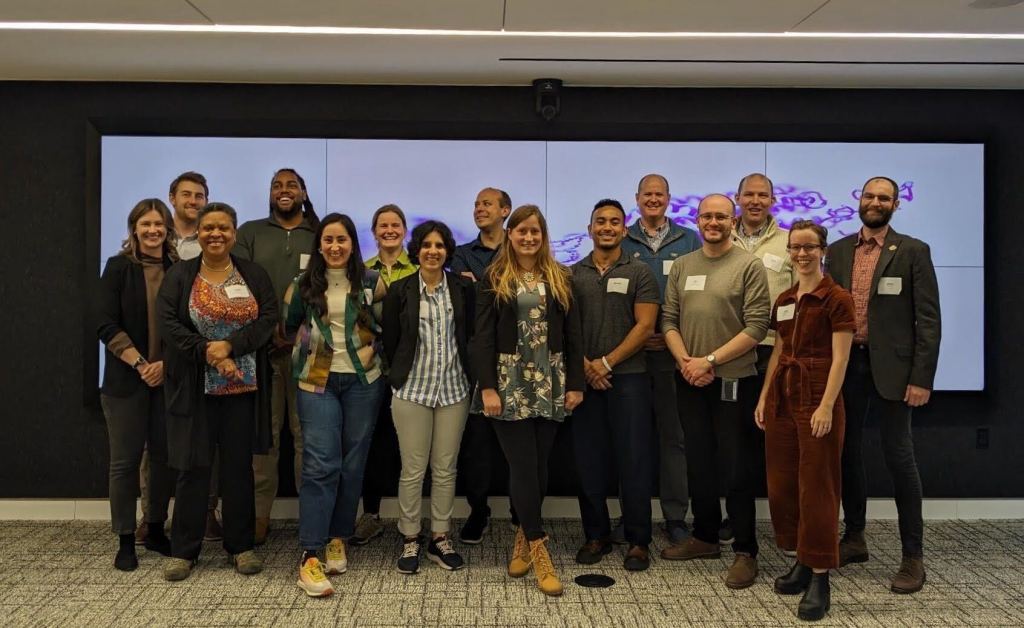
Washington, DC—On the evening of January 9th, thought leaders in science and policy converged at the Rockefeller Foundation to kick off a two-day event dedicated to responsible biosecurity innovation. Titled Biodesign in Focus, the reception featured a series of illuminating talks that explored advancements in protein structure prediction and AI-driven design. These talks set the stage for the Responsible Biodesign Workshop, held the following day.
The evening began with Samuel Curtis, the Rosetta Commons biosecurity fellow, and Andrew Hebbeler, director of biosecurity at CEPI (Coalition for Epidemic Preparedness Innovations), addressing the meeting. Their opening remarks underscored the urgency of balancing rapid scientific innovation with biosecurity safeguards. “The success of global vaccine efforts hinges on ensuring AI technologies are wielded responsibly,” Hebbeler noted, referencing CEPI’s 100 Days Mission—CEPI’s aspiration is for the world to be able to respond to the next Disease X with a new vaccine in just 100 days.
The reception’s central focus was a presentation series designed to educate policy professionals on AI’s role in modern biosecurity. Mohammed AlQuraishi of Columbia University provided a historical overview of protein design, tracing breakthroughs from early physics-based models to AI-driven innovations like AlphaFold and RF Diffusion. “ The field has been around for several decades, but the last couple of years have been an absolute renaissance,” he said, highlighting how these tools reshape structural biology and therapeutic development.
Michael Chungyoun, a Ph.D. student from Johns Hopkins University, showcased DL4Proteins, an open-source educational platform offering AI tutorials for protein design. “There’s a huge gap between novel AI models and accessible education,” he explained, detailing how the project addresses barriers such as limited access to GPU resources and the complexity of technical literature. These notebooks have already become core teaching materials in academic courses, democratizing access to advanced AI methods.
The third and final talk, led by Clara Schoeder of Leipzig University, detailed how AI accelerates vaccine development to combat emerging pathogens. Schoeder emphasized the precision required in antigen design: “ We want to be as good as fast as possible at making these antigens.” Her lab uses computational design to enhance antigen stability and yield, testing iterations in experimental and preclinical models.
The event was about education and collaboration. Scientists and policymakers mingled to discuss how AI tools, if responsibly harnessed, can mitigate global biosecurity risks while accelerating innovation. CEPI, Rosetta Commons, and partners like Sentinel Bio and the Open Molecular Software Foundation underscored their joint commitment to advancing the Community Values, Guiding Principles, and Commitments for the Responsible Development of AI for Protein Design.
The workshop the following day continued these efforts, expanding discussions on AI oversight, ethics, and security frameworks. Attendees from both scientific and policy domains expressed optimism about the collaborations forged at the event. With global pandemics fresh in collective memory, the need to harmonize science and governance has never been more pressing.
The Biodesign in Focus recordings, which include full presentations from the event, are now available online (Schoeder’s video is unfortunately truncated due to a technical glitch). This series is part of Rosetta Commons’ ongoing commitment to the responsible development of AI tools in protein design.
The playlist includes:
- Introductory remarks by Samuel Curtis (Rosetta Commons) and Andrew Hebbeler (CEPI)
- A Brief History of Protein Structure Prediction and Design by Mohammed AlQuraishi
- DL4Proteins: Open-source Notebooks for Teaching AI in Protein Design by Michael Chungyoun
- Vaccine Development to Combat Pandemic-level Threats Using AI in Protein Design by Clara Schoeder
The Responsible Biodesign Workshop, held on January 10th, built on the themes introduced during the Biodesign in Focus reception, bringing together leading scientists, policymakers, and industry experts to discuss AI’s role in biosecurity and public health resilience. The workshop opened with a presentation of the Community Statement, reinforcing shared commitments to the responsible development of AI-powered biomolecular design. Across four expert-led sessions, speakers explored the evolving biosecurity landscape, the application of biodesign tools for pandemic preparedness, regulatory challenges at the digital-to-physical interface, and strategies for implementing responsible AI commitments. Discussions highlighted both the promise and risks of AI-driven molecular design, emphasizing the need for governance frameworks that balance innovation with security.
The workshop underscored the critical role of cross-sector collaboration, as scientists provide essential insights into real-world applications of AI-driven biodesign, while policymakers ensure that regulatory frameworks address emerging risks. By bridging this gap, both groups can work together to develop policies that are informed, practical, and capable of keeping pace with technological advancements without stifling innovation.