
Two-phase computational pipeline yields high-affinity de novo BMP-2 binders for bone regeneration
Key Takeaways
- By combining Rosetta-based motif grafting with deep-learning tools like RFdiffusion, ProteinMPNN, and AlphaFold2, a two-phase approach successfully generated functional binders where Rosetta-based docking and scoring alone failed.
- The lead binder, BB5523, demonstrated high affinity and specificity with an apparent KD of 2.07 nM for BMP-2, backed by mutational analysis confirming T42 as a key hotspot residue within a partially hotspot-driven, distributed β-sheet interface.
- BB5523 reduced BMP-2-induced osteogenic activity in C2C12 myoblasts nearly back to baseline levels, highlighting its potential for controlled ligand modulation.
Researchers from the Hosseinzadeh Lab at the University of Oregon shared their development of a two-phase computational design pipeline to create de novo protein binders against the knuckle epitope of bone morphogenetic protein 2 (BMP-2) in a recent preprint. By pairing Rosetta-based computational modeling and design with deep-learning refinement, the approach achieves high-affinity binding to tune growth factor signaling rather than relying on high-dose delivery.
Overcoming challenges in growth factor signaling
Nonunion bone fractures represent a significant clinical burden, but current therapeutic approaches using bolus growth factor administration face strict limitations. High doses of BMP-2 can trigger severe adverse side effects, including ectopic ossification and off-target inflammation. Because endogenous BMP-2 signaling is tightly regulated through interactions with cell-surface receptors (BMPR-I and BMPR-II) and natural inhibitors like Noggin, precise therapeutic modulation requires binding strategies capable of fine-tuning protein availability. However, targeting the structurally complex, β-sheet-rich knuckle epitope responsible for BMPR-II binding is difficult using conventional design workflows that favor α-helical architectures.
A hybrid strategy integrating deep learning and Rosetta-based computational modeling
To address this structural challenge, the researchers established a two-phase computational design framework. In Phase I, PyRosetta-based β-strand motif grafting (grafting short BMP-2 knuckle motifs onto curated scaffold backbones) and docking protocols generated an initial library of 264 candidate binders with favorable Rosetta scores and docking metrics. However, these candidates failed to demonstrate measurable binding experimentally.
“While this result was initially disappointing, it ultimately became one of the most important lessons of the project,” said Ben Burress, lead author of the paper. “Those failures motivated us to rethink our approach and incorporate deep learning-guided design strategies.”
This became Phase II of the project, where the top Phase I scaffold as a structural seed for partial RFDiffusion backbone refinement and ProteinMPNN sequence optimization. Candidates were then evaluated using AlphaFold2 confidence metrics, generating 22 refined constructs for experimental testing.
Lead construct demonstrates high affinity and specific contact points
Experimental evaluation identified a lead construct, named BB5523, that exhibited dose-dependent, high-affinity binding to BMP-2 with an apparent equilibrium dissociation constant (KD) of 2.07 nM via biolayer interferometry. Circular dichroism confirmed that BB5523 maintains a stable, well-folded structure. Targeted single-point alanine substitutions along the designed β-strand interface revealed key energetic contributions. Mutating residue T42 significantly disrupted binding affinity, demonstrating a hotspot interaction, while I44A and L46A variants showed more modest affinity reductions. Notably, the interaction is only partially hotspot-driven; even the triple alanine variant retained measurable nanomolar binding, demonstrating that binding is also supported by distributed backbone interactions across the interface.
Cell assays demonstrate attenuated osteogenic differentiation
To evaluate biological activity, researchers tested the constructs in C2C12 myoblast cell lines. Neither BB5523 nor control affibodies induced osteogenic differentiation on their own. However, when complexed with BMP-2, BB5523 reduced BMP-2-induced alkaline phosphatase (ALP) activity—a key marker of osteogenic differentiation—nearly back to baseline levels. This demonstrates that high-affinity engagement with the knuckle epitope can tune growth factor signaling in cellular environments.
Broad applicability to extended β-sheet interfaces
Beyond BMP-2, this two-phase methodology provides a generalizable computational blueprint for targeting growth factors and protein interfaces defined by complex β-sheet interactions. Future applications include co-designing these engineered binders with biomaterial matrices—such as hydrogels or scaffolds—to enable localized growth factor retention and controlled delivery in regenerative medicine.
‘I hope this work helps demonstrate how traditional protein design methods and modern AI approaches can be combined to solve difficult biological problems with applications from therapeutics to environmental challenges,” said Ben. “For this research, we hope to contribute to future therapies that help restore normal bone healing while minimizing unwanted sides effects by improving our ability to design proteins that precisely regulate the signaling pathways involved in bone formation.”
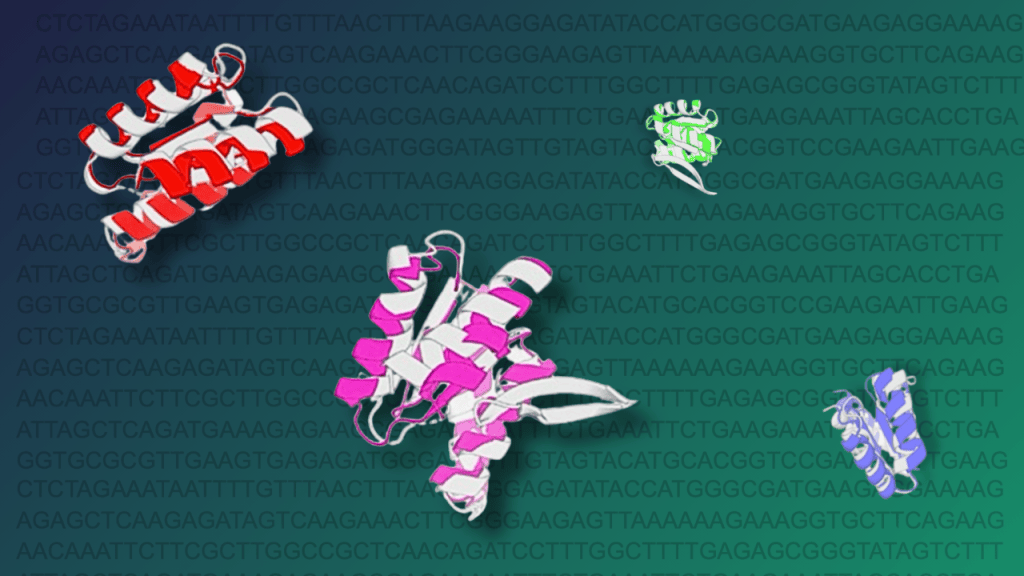
Image inspired by Fig. 4A from Burress et al. (2026).