
High-Throughput Protein Purification: From Linear DNA to Pure Protein in Three Days
Key Takeaways
- An engineered His-tagged SUMO protease was developed to release SUMO-tagged proteins directly from nickel-charged magnetic beads. This on-bead cleavage eliminates conventional high-imidazole elution and simplifies downstream processing, enabling purified proteins to be recovered directly in the desired buffer.
- Bypassing unnecessary intermediate steps and integrating the process into a continuous workflow enables a complete end-to-end DNA-to-protein production cycle in three days.
- A protein production workflow was designed around 96- and 24-well plates, allowing cloning, transformation, expression, purification, and post-production processing to be performed in parallel and integrated with liquid-handling automation.
- The platform successfully produced over 90% of a benchmark set comprising 96 structurally diverse mesophilic proteins at high purity.
A paper by Cárcamo-Noriega et al. from Chris Bahl’s lab at AI Proteins introduces a streamlined workflow that could reshape how labs produce proteins at scale. The method tackles key bottlenecks across the entire protein production pipeline and is designed to be fully compatible with automation—allowing researchers to go from lineal DNA to 96 pure, ready-to-use proteins in just three days.
Where does protein production become a bottleneck?
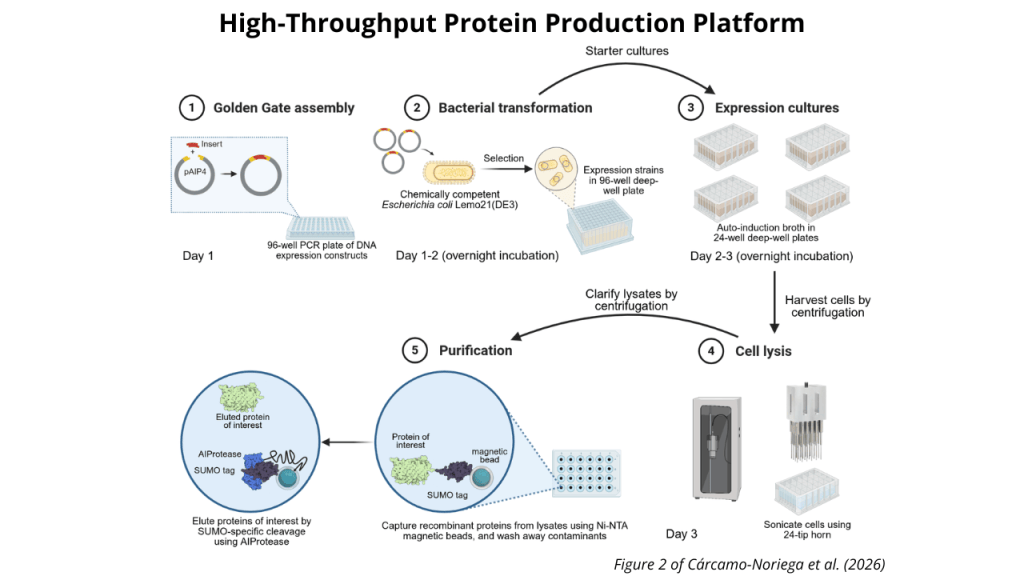
Traditional protein production workflows work well for individual proteins, but become increasingly labor-intensive and difficult to scale when dozens or hundreds of proteins are needed. These bottlenecks were addressed by redesigning each step for parallel processing. Golden Gate cloning in a 96-well format eliminated the need for individual colony isolation, while liquid selection and autoinduction simplified the transition from DNA to expression cultures. Protein production was then moved into 24-well plates, allowing cultures to be processed in parallel and integrated with automated liquid handling. For purification, nickel-charged magnetic beads replaced conventional chromatography columns, enabling binding and washing directly in multiwell plates. Finally, an engineered SUMO protease containing a long, intrinsically disordered protein linker (CAHS_107838 from Paramacrobiotus richtersi) between an N-terminal 10His tag and a Chaetomium thermophilum SUMO protease domain enabled on-bead cleavage of the SUMO tag, releasing the target protein directly into the desired buffer and eliminating additional imidazole elution and buffer-exchange steps.
Benchmark Testing Confirms High Yields Across Diverse Protein Structures
To validate the platform’s versatility, the authors evaluated a benchmark set of 96 structurally diverse, single-domain mesophilic proteins representing 64 CATH superfamilies. Using automated liquid-handling protocols, the workflow achieved:
- High Success Rate & Yield: Successfully produced 87 out of 96 proteins (>90% success rate), yielding >100 µg from 2 mL cultures at >90% purity.
- Cooperative Folding: 78% displayed cooperative thermal unfolding via differential scanning fluorimetry (DSF).
- Monodispersity: 61% exhibited monodisperse profiles on analytical size-exclusion chromatography (aSEC).
- Structural Integrity: 74% generated circular dichroism (CD) spectra consistent with their predicted structural topologies.
Generating Curated Datasets for Protein Engineering and Computational Modeling
By standardizing every step from gene synthesis to biophysical characterization, this automated platform provides high-quality material for basic research and mutational screening. Furthermore, the curated biochemical and biophysical data collected across the 96 benchmark proteins offer a standardized, labeled dataset ideal for machine learning and computational modeling applications.