
Integrating Ion Mobility Data with Rosetta and AlphaFold Resolves Complex Structural Assembly Challenges
Key Takeaways
- Combining low-resolution structural data from ion mobility mass spectrometry with computational docking tools significantly improves predictions for challenging multi-subunit protein complexes.
- The integrative approach fixes frequent symmetry and assembly errors made by deep learning tools like AlphaFold-Multimer, elevating a majority of failed predictions to native-like accuracy.
- The underlying scoring tools are now available within the Rosetta modeling suite, providing a practical framework for integrating sparse physical data into structural modeling.
In a recent publication in Analytical Chemistry, researchers from Steffen Lindert’s lab, including first author Akshaya Narayanasamy, and colleagues introduced a novel integrative computational framework that combines deep learning predictions with sparse experimental data to resolve challenging multi-subunit protein structures. By coupling AlphaFold-predicted subunits with Rosetta docking and guiding model selection using collision cross section measurements from ion mobility mass spectrometry, the team demonstrated a way to overcome persistent accuracy limits in modeling complex quaternary assemblies.
Combining physical shape measurements with docking algorithms overcomes limitations when assembling multi-subunit protein complexes
Predicting the three-dimensional structures of protein complexes remains a crucial challenge for understanding cellular function and guiding drug discovery. Deep learning models like AlphaFold-Multimer have advanced structural biology, but they frequently struggle when predicting how multiple subunits fit together. Even when individual protein chains are modeled accurately, predictions often misjudge overall symmetry, misplace subunit interfaces, or fail to capture the correct assembly topology.
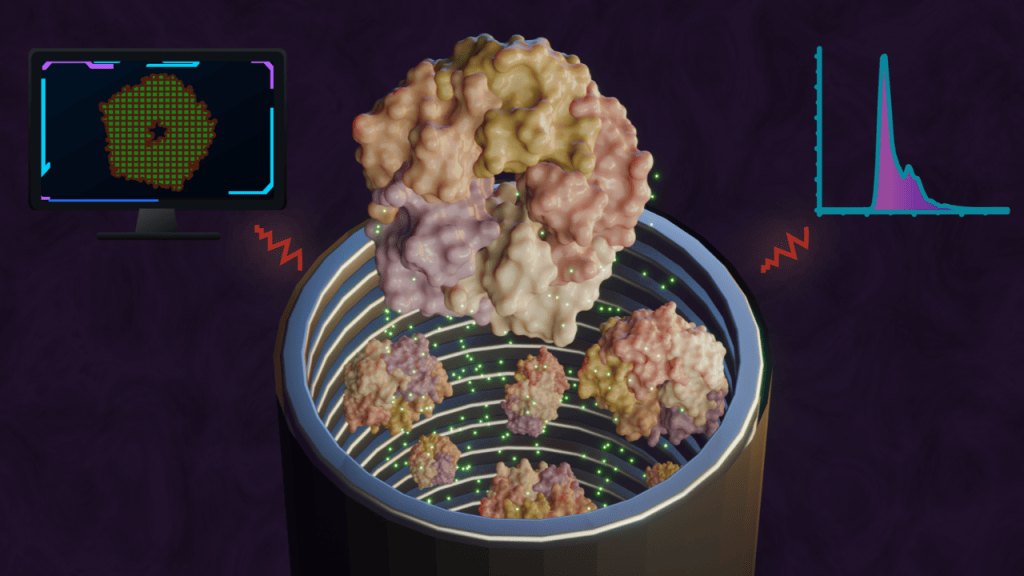
To address these limitations, researchers built an integrative workflow that pairs computational subunit models with experimental shape data from ion mobility mass spectrometry. By measuring how protein ions travel through gas, ion mobility mass spectrometry provides a single structural metric, the collision cross section, that reflects the overall size and shape of an assembly. Researchers updated Rosetta’s shape-calculation algorithm and created a custom scoring term that penalizes docking arrangements that deviate from expected physical dimensions.
Physical shape constraints drive major gains in assembly accuracy
When evaluated on a benchmark set of complex targets where deep learning tools initially failed, the integrative pipeline dramatically improved structure quality. Incorporating shape constraints helped the docking algorithm select native-like arrangements, correctly restoring assembly symmetries and subunit interfaces. Overall, the method improved structural accuracy for over two-thirds of the challenging assemblies tested, converting most of those failed targets into near-native, accurate predictions.
The method was further validated using physical experimental measurements across a range of well-studied protein assemblies. Including experimental mass spectrometry data consistently improved structure selection across the benchmark set, effectively guiding models toward native arrangements without degrading performance on any target.
Integrating open-source mass spectrometry tools into Rosetta creates new opportunities for hybrid structural biology modeling
The new scoring applications are freely available within the Rosetta software suite, offering structural biologists an efficient tool to resolve difficult assemblies. Looking ahead, incorporating mass spectrometry data directly into deep learning architectures and combining it with other experimental techniques such as cryo-EM and NMR holds great promise for further accelerating structural discovery.