
News from RC
Science, Connection, and Community: Summer RosettaCon 2026 Recap
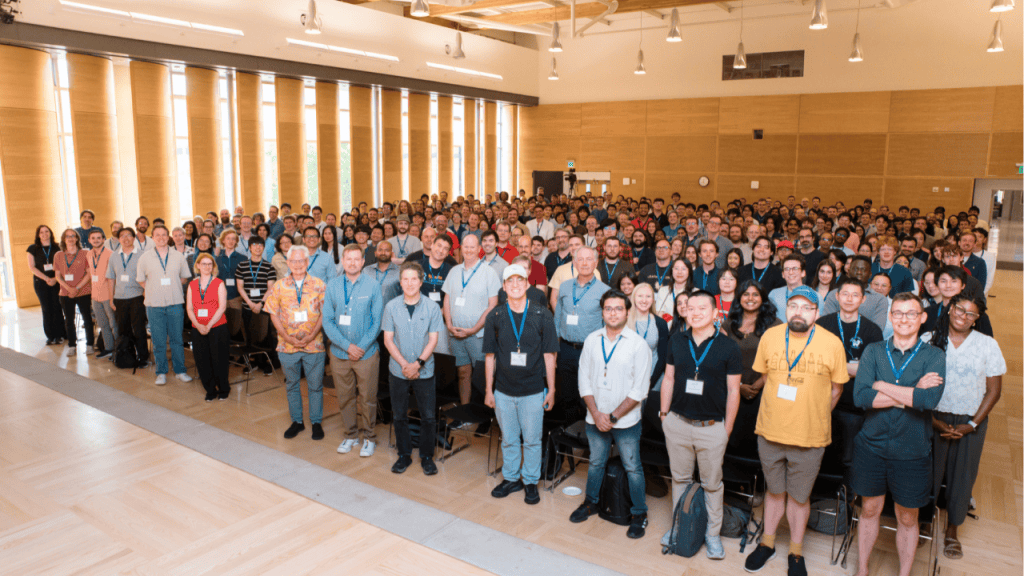
Featured image is a group photo of Summer RosettaCon 2026 in-person attendees. With over 600 in-person and virtual attendees, 56 scientific talks, nearly 200 posters, 16 breakout sessions, 5 keynotes, 4 career panels, 3 tutorials, and countless networking opportunities, Summer RosettaCon 2026 was our largest event to date. Hosted for the first time at the…
Read MoreSpeed Up PyRosetta Development with Autocompletion and Type Checking
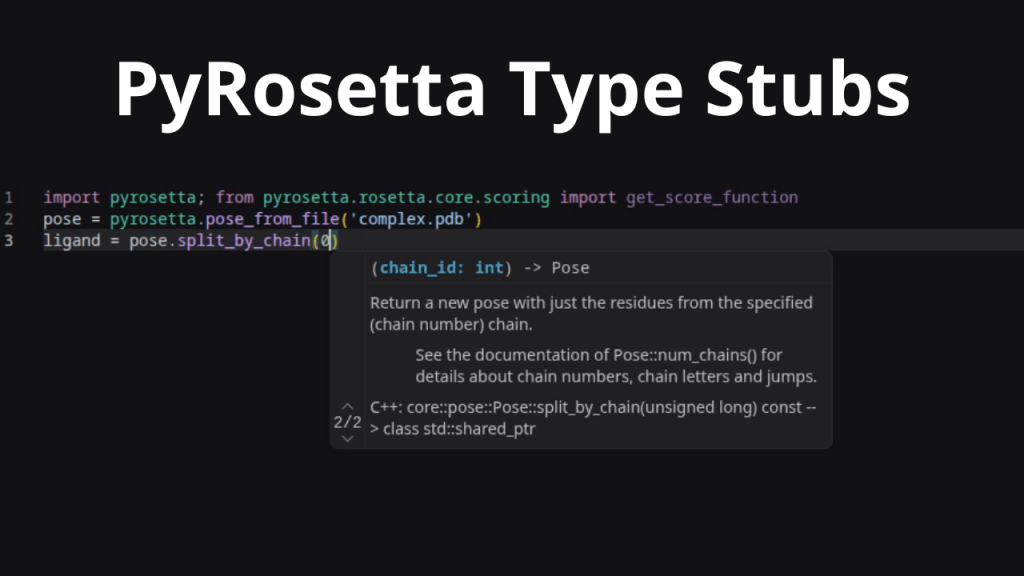
By Harrison Truscott PyRosetta, the Python interface to the Rosetta binary, now comes packaged with type stub files (.pyi). These files describe the module’s classes, methods, and variables, as well as function signatures, types of function parameters and return values, and descriptive docstrings. Type stub files can be used by the Integrated Development Environment (IDE)…
Read MoreLet’s Get Social: New Ways to Connect with @RosettaCommons
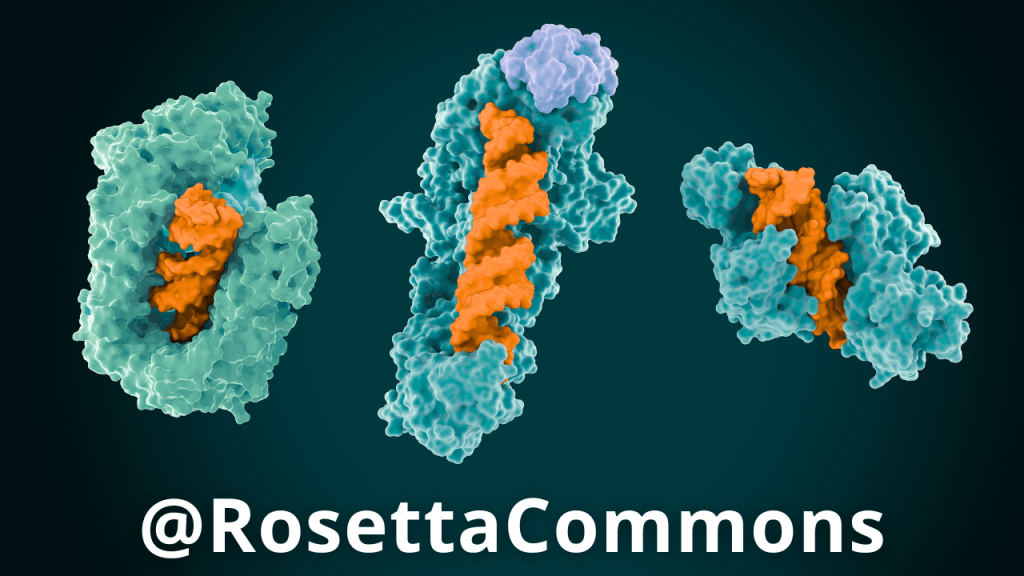
Rosetta Commons is a community based on sharing scientific discoveries and fostering collaborations to advance our understanding of protein design and modeling. In order to stay connected with the community, we are introducing a refresh of three of our social media channels and one new channel! Just click on the links below to go to…
Read MoreRosetta Commons Run (rc-run) Now Available

We are pleased to announce a new Rosetta Commons workflow optimization tool: rc-run. rc-run (invoked as rc) is a command-line utility tool for running containerized and native biomolecular software. It simplifies common tasks, such as mounting local directories, building HPC containers, running containerized applications, and logging executed commands, to make complex workflows easier to reliably…
Read MoreAngela Colbert joins Rosetta Commons as Communications Lead

Angela Colbert, Ph.D., joined us on February 23 as our new Communications Lead. She comes to us from NASA’s Jet Propulsion Laboratory, where she spent the past five years leading science communication initiatives for major Earth science efforts. In that role, she translated complex climate and satellite data into clear, high-impact stories across web, multimedia,…
Read MoreFoundry Docker Image Now Available

Rosetta Commons now offers an official Foundry Docker image designed to make it dramatically easier to run cutting-edge biomolecular machine learning models without complex setup. Foundry is the central repository for a suite of ML models used in protein science—including RF3 (a next-generation biomolecular structure prediction network), ProteinMPNN inverse-folding models, and the newest RFdiffusion3 (RFD3)…
Read MoreDocumentation Playbook Now Available

The Documentation Playbook is a new guide designed to make writing and maintaining documentation for your software projects clearer and easier. The Documentation Playbook is part of the Playbooks Project from the Open Molecular Software Foundation (OMSF). What’s inside: An overview of the different types of documentation that are useful for open-source scientific software projects…
Read MoreRosetta Commons postdoc info sessions happening soon
The JEDI committee is hosting a two-part virtual info session spotlighting postdoctoral opportunities across the Rosetta Commons. Interested PIs will give short, focused overviews of their research and lab environments (1–2 slides each), followed by a live Q&A. This is a great chance for prospective postdocs to get a feel for different labs and research…
Read MoreProtein design workflows series kick off with Protflow and Ovo
On January 20, the protein design community kicked off a new Protein Design Workflows meeting series focused on how people are building, running, and scaling protein design pipelines in practice. The goal of this series is simple: create a space where developers and users can present real workflows, compare approaches, and identify opportunities for shared…
Read MoreTech Tea Time – New Community Meeting series

Our first TechTeaTime, a new community meeting series event, happened on January 26, with 46 people joining. Rafi Brent (Baker Lab, University of Washington) gave a tutorial on protein binder design with RFD3, which will be available on Youtube shortly. The meeting details for future meetings, including the Zoom link, can be found on the…
Read More