
A Zero-Shot Approach to de novo Metalloenzyme Design
Key Takeaways:
- dEVA (design by EVolutionary Algorithm) is a framework that achieves the zero-shot design of a highly efficient metalloenzyme without any reliance on natural templates.
- Design objectives were tailored to the specific chemistry of metalloenzymes, in particular catalytic zinc sites, and from only three experimentally-tested designs found desB, the most efficient de novo designed hydrolase to date.
- The zero-shot approach opens possibilities for designing bespoke enzymes for industrial, environmental, and therapeutic applications not found in nature.
In a new study published on bioRxiv, researchers from Stanford University and EPFL introduce dEVA (design by EVolutionary Algorithm), a framework that achieved the zero-shot design of a highly efficient metalloenzyme without any reliance on natural templates.
dEVA shows that de novo design of enzymes is possible
When looking for catalytic activity in proteins, design strategies have often focused on scaffolding around known catalytic motifs derived from nature. However, this limits us to what evolution has already discovered. This study demonstrates that there is potential to move beyond scaffolding into true de novo designs by using modular frameworks like dEVA that balance multiple biophysical objectives. “Evolution has gotten us far, but this research pushes us into new territory of what is possible in enzyme design,” said Gina El Nesr, the first author of the paper.
“Enzymes are remarkable because they touch so many parts of our lives, from medical applications to everyday products, even laundry detergent,” said Gina. This zero-shot approach paves the way for designing bespoke enzymes for industrial, environmental, and therapeutic applications that nature never had a reason to evolve.
The dEVA framework included retraining models on catalytic zinc sites
Inspired by how nature optimizes function through iterative selective pressure, dEVA uses a multi-objective genetic algorithm (NSGA-II) to optimize for multiple biochemical criteria simultaneously. Instead of seeking a single perfect score, it identifies a design solution at the Pareto front where different objectives—like sequence-structure compatibility and metal-binding probability—are mutually optimized.
A key innovation was tailoring the design objectives to the specific chemistry of metalloenzymes. To do this, the team trained a specialized model, Metal3D-Cat, specifically on annotated catalytic zinc sites to learn the unique chemical environments that govern catalysis.
The team first validated dEVA by designing simple metalloproteins. One standout, desH2C2, featured a His2Cys2 coordination site that proved to be a de novo motif unique from any characterized proteins in the Protein Data Bank (PDB).
The researchers also highlighted a cautionary tale for AI-driven design. They found that standard models (and even AlphaFold-3) could assign high confidence to biologically implausible, single-ligand zinc sites because deep learning training sets are often trained on the non-biological zinc ions that appear solely from crystallization conditions. By retraining their models on a filtered clean dataset, they were able to improve recall on biological metals and eventually for metals facilitating enzymatic functions.
desB: A de novo phosphatase with natural-level efficiency
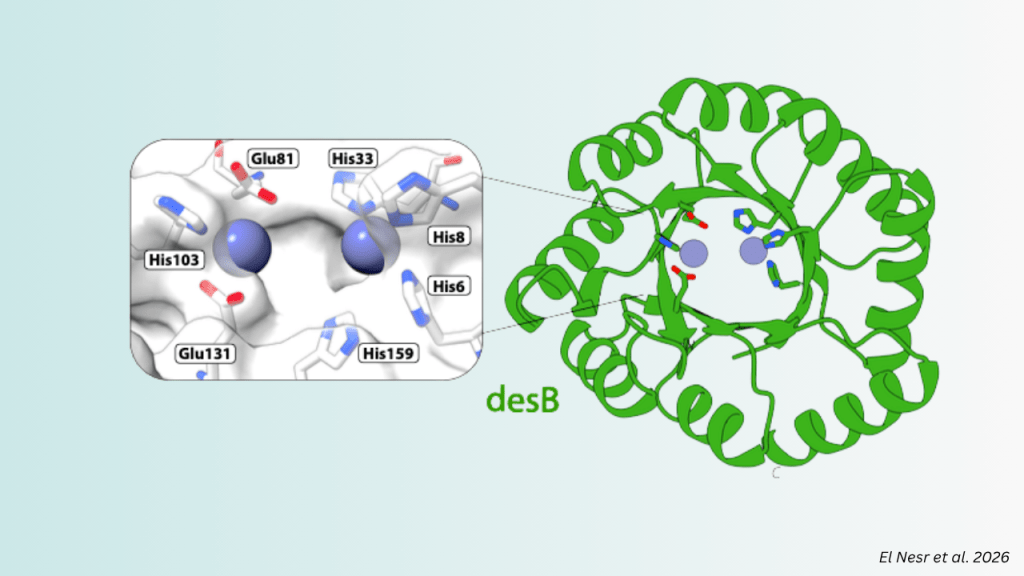
The pinnacle of the study is desB, a de novo designed TIM-barrel protein harboring a bi-nuclear zinc active site. This design is remarkable for several reasons:
- Zero-Shot Novelty: The active site motif has no structural precedent in nature and no sequence homologs.
- Exceptional Efficiency: It has an absolute catalytic efficiency (kcat/KM) comparable to natural enzymes, but catalyzes the hydrolysis of phosphomonoesters with a rate enhancement of up to 3 x 10¹³—the highest reported for any de novo designed hydrolase to date.
- Substrate Promiscuity: Like the generalist catalysts thought to exist at the dawn of evolution, desB is promiscuous, efficiently hydrolyzing both phosphomonoesters and more chemically demanding phosphodiesters.
“This study was especially exciting for me because it’s the first time we as a field have successfully used de novo design for an enzyme catalyzing some of the highest energy barrier reactions in biology,” said Gina. She added, “I’m excited to see what other reactions we can tackle across the other five enzyme classes, beyond hydrolases, and to see how enzyme design evolves over the next few years.”
The preprint paper by Gina El Nesr et al. from the lab of Po-Ssu Huang was posted on bioRxiv on April 24, 2026.