
Integrating Mass Spectrometry Restraints into Rosetta and AlphaFold Modeling Pipelines
Key Takeaways
- Integrating mass spectrometry data with computational modeling platforms like Rosetta and AlphaFold2 improves the accuracy of protein structure and complex predictions.
- Experimental data from techniques such as covalent labeling, ion mobility, and surface-induced dissociation help distinguish native-like protein conformations from inaccurate computational outputs.
- A new set of tutorials and updated PyRosetta implementations make these integrated structural mass spectrometry pipelines accessible to non-expert users.
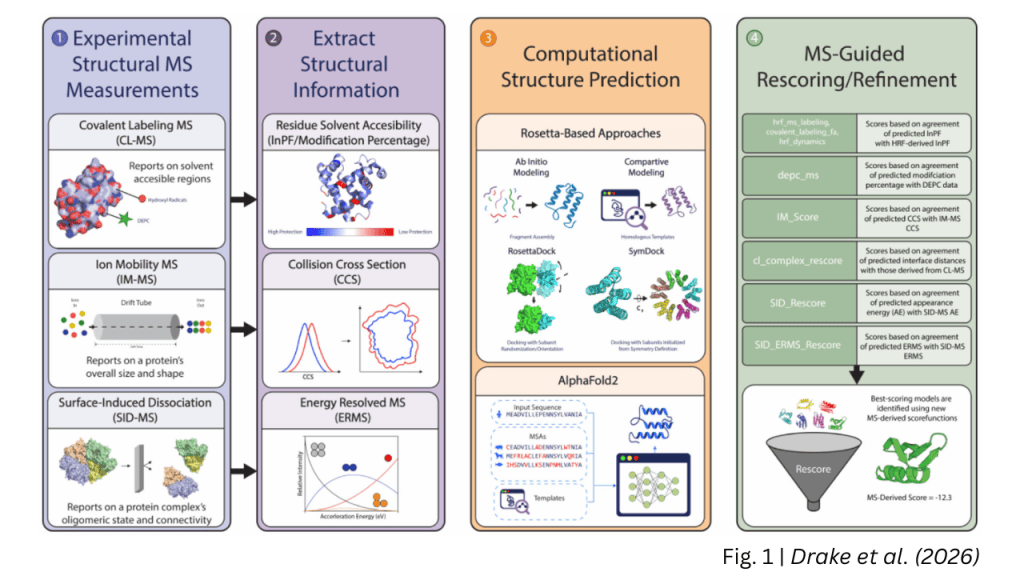
In a recent paper by Zach Drake and other members from the Lindert Lab, a step-by-step tutorial is provided to learn how to combine structural mass spectrometry data with Rosetta and AlphaFold2 to enhance computational protein structure prediction accuracy.
Combining structural mass spectrometry and computational prediction
Accurate three-dimensional protein structures are critical for understanding biological functions, subunit connectivity, and molecular interactions. Structural mass spectrometry (MS) techniques—including covalent labeling, ion mobility, and surface-induced dissociation—provide valuable information about residue exposure, overall shape, and complex topology. However, MS measurements alone cannot fully resolve atomic-level protein structures, while standalone computational methods like Rosetta or AlphaFold2 can suffer from limited conformational sampling or generate unvalidated predictions. Integrating experimental MS data as structural constraints within computational pipelines provides a reliable way to guide structural models toward native-like conformations.
Implementing accessible workflows for structural modeling
To lower the barrier to entry for researchers with limited computational experience, a comprehensive suite of step-by-step tutorials was compiled. “The challenge was taking methods developed independently, with different applications, experimental data types, and scoring approaches, and turning them into clear, reproducible workflows that someone new to the field could follow,” said Zach Drake, postdoc at UCLA and lead author on the paper.
The initial protocols cover baseline computational structure generation using Rosetta (for ab initio folding, comparative modeling, and protein-protein docking) alongside deep-learning predictions via AlphaFold2. Building on these foundational methods, subsequent workflows demonstrate how to integrate MS experimental data directly into structural modeling. This experimental integration is achieved either through custom Rosetta score terms during sampling or via standalone rescoring applications designed to evaluate pre-generated model ensembles.
Rescoring models with experimental mass spectrometry metrics
The scoring and rescoring protocols evaluate structural models using data derived from several mass spectrometry techniques. For monomeric proteins, residue-level solvent accessibilities from hydroxyl radical footprinting (HRF) and diethyl pyrocarbonate (DEPC) labeling are scored against predicted solvent exposure metrics using terms such as hrf_ms_labeling, covalent_labeling_fa, hrf_dynamics, and depc_ms. For protein complexes, differential covalent labeling metrics and surface-induced dissociation (SID) energy-resolved mass spectrometry distributions are evaluated using rescoring applications like cl_complex_rescore and SID_ERMS_Rescore to verify subunit topology and interface proximity. Furthermore, collisional cross-section (CCS) values from ion mobility mass spectrometry can be compared against calculated structural metrics using dedicated algorithms.
Validating metrics with updated PyRosetta tools
The framework provides instructions for calculating structural metrics—such as solvent accessibility, CCS, and energy-resolved MS data—to enable direct comparison between computational structures and experimental outputs. As part of this work, new PyRosetta implementations were introduced for the PARCS algorithm (Projection Approximation using Rough Circular Shapes for fast CCS calculation) and the SID_ERMS_Rescore application. These implementations allow researchers to calculate physical metrics directly within Python environments and rescore structural candidates to confirm agreement with physical measurements.
Extending structural workflows to integrative biology
By combining physics-based or deep-learning predictions with experimental MS constraints, these workflows allow researchers to effectively filter out non-native structural predictions. The presented methodologies provide a practical toolkit for structural biologists aiming to incorporate mass spectrometry data directly into routine computational structure prediction and complex modeling pipelines.
“Although this tutorial is primarily intended for protein scientists, I think its broader goal is to help lower the barrier for using powerful scientific tools in research areas that can benefit everyone, such as drug development and understanding diseases,” said Zach. “Computational methods have advanced dramatically, but integrating them with experimental insights can produce more grounded and reliable predictions making those approaches more accessible to aid informed scientific decisions.”