
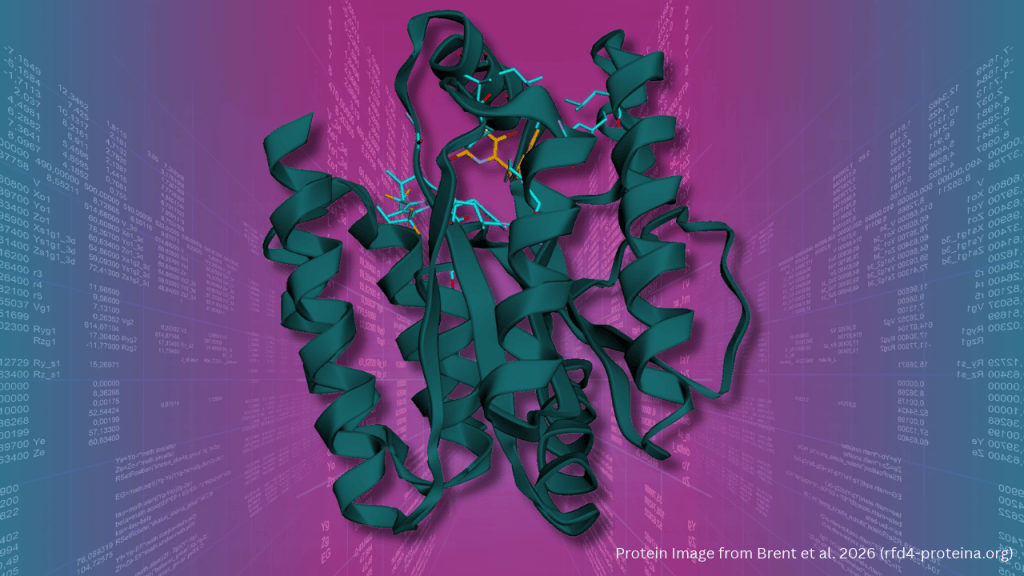
RFD4-Proteina Improves Computational Protein Design through Open Science and Collaboration
Collaboration across the biomolecular modeling and design community continues to drive scientific advancements and discoveries. One way those collaborations shine is through improvements to the accuracy and computational efficiency of AI-based protein design models. In turn, those improvements expand what is possible across medicine, biotechnology, and beyond. The development of RDF4-Proteina, which was released earlier this week, highlights this process in action.
RFD4-Proteina is the next generation of RFdiffusion from the Institute for Protein Design (IPD). Developed in collaboration with NVIDIA, RFD4-Proteina is open source and publicly available through the Rosetta Commons GitHub organization. Building upon previous models, including RFdiffusion, RFdiffusion2, and RFdiffusion3, and incorporating advances from NVIDIA’s Proteina model, RFD4-Proteina delivers advances in computational efficiency and design accuracy, enabling researchers to explore complex protein design challenges faster and more efficiently. Early IPD users reported reductions in design timelines (in some cases, from months to days), demonstrating the potential to accelerate research across therapeutics, materials science, and environmental applications.
In addition to enhanced speed and computational efficiency, the model can be used to explore ligand-protein interactions, binding to nucleic acid chains, antibody design, and much more. Moreover, its novel latent-space approach provides researchers with greater precision for chemical generalization and unifies the structure-generation and sequence-generation steps.
Collaborations Across Academia and Industry Lead to Scientific Advancements in Protein Design
These advances reflect a broad collaboration across academia and industry that extended beyond IPD and NVIDIA to include Rosetta Commons, the Open Rosetta project at OMSF, and the OpenFold Consortium (also a part of OMSF). Tapping into the expertise needed to accomplish a shared goal helped to speed up the development process. This allowed RFD4-Proteina to be released far sooner than otherwise would have been possible, and centralizes it as an open resource for the biomolecular modeling and design community.
Two OpenFold Fellows, Nathaniel Corley and Rohith Krishna, who are hosted at IPD, were integral to the model’s development, with Nate being one of the lead developers. Rosetta Commons team member Rachel Clune (Open Rosetta at OMSF) aided in the development of the corresponding documentation and tutorials alongside NVIDIA who has provided technical guidance. Rosetta Commons team member Rocco Moretti (Vanderbilt University) provided guidance on the submodules in Rosetta Commons’s Foundry, where the model is hosted, and team members Hope Woods (Open Rosetta at OMSF) and Sergey Lyskov (Johns Hopkins University) significantly expanded Foundry’s unit test coverage.
The release of RFD4-Proteina also coincides with a formal release of TMol and relies on the newly released version of AtomWorks, which is also hosted in the Rosetta Commons GitHub organization. TMol is a GPU-accelerated version of Rosetta scoring and structure relaxation. It was created by Frank DiMaio (IPD), Andrew Leaver-Fay (Genentech), and other members of the IPD, including Kieran Didi. TMol is used in the RFD4-Proteina workflow to evaluate the created designs. The new version of Atomworks was made possible by expansive contributions from the OpenFold Consortium’s Jennifer Wei and Jan Domański. RFD4-Proteina uses Atomworks’ extensive API for model training and inference.
Working together, the scientific and technical exchanges between all collaborators supporting the model’s release contributed toward building a robust ecosystem where researchers can access the tools they need as they tackle today’s toughest challenges. And that ecosystem of biomolecular modeling and design researchers, continues to add to a growing impact of applications across medicine, materials, and sustainability.
Explore More About RFD4-Proteina
To learn more about RFD4-Proteina, explore the resources below and keep an eye out for upcoming video and written tutorials.